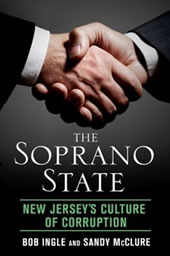
Prospect Park Councilman Anand Shah checked all the boxes for top billing in The Soprano State’s Culture of Corruption.
Shah admitted working for a gambling operation with mob ties and admitted using the proceeds to boost his political future.
And in true Soprano State style, despite his 2025 arrest on the gambling charges, Shah was successfully reelected to the Prospect Park Council.
His case also is a reminder that the mob is alive and well in the Soprano State.
“Traditional organized crime remains a real problem in New Jersey,” said state Criminal Justice Director Theresa Hilton. “Even with a variety of legal gambling options, illegal gambling rings run by organized crime continue to operate in backrooms and online.”
Shah pleaded guilty to working as a sports booking agent and poker manager in a gambling operation tied to the Lucchese crime family and to allowing gamblers to pay off their debts by contributing to his political campaign.
Under the plea agreement, Shah faces 10 years in prison on charges of racketeering, money laundering and official misconduct. He is permanently barred from holding public office.
Shah’s activities contributed $900,084 to the organized crime gambling operation from 2017 to 2023, according to prosecutors. He is one of 42 persons indicted in the wake of a two-year investigation into the gambling operation overseen by the leadership of the New Jersey faction of the Lucchese crime family, investigators said. The gambling, loansharking, extortion and money laundering raked in $4.79 million for the crime family, prosecutors said.
Last year, Shah denied taking part in the crime ring, NJ.com reported.
See Chapter 8, “The Gospel According to the Mob,” of The Soprano State for more on the Lucchese organized crime family, whose capo (captain) Michael Taccetta is described by crimelibrary.com as the real-life Tony Soprano.
Attorney General Jennifer Davenport, Aug. 28, 2026; Alec Sturm, NJ.com, Aug. 28, 2026
The case charging powerful political boss George Norcross with racketeering conspiracy and political “bloodsport” collapsed.
Acting state Attorney General Jennifer Davenport will not make a final appeal to the New Jersey Supreme Court after an appellate panel agreed with Superior Court Judge Peter Warshaw, who said Norcross’ behavior amounted to New Jersey style hardball, not a crime.
Norcross’ high profile defense attorney Michael Critchley said former state Attorney General Matthew Platkin, who filed the charges, “will now have to answer for his prosecutorial overreach to achieve a personal political agenda,” NJ.com reported.
Platkin’s response: “I will never apologize for believing that everyone should be held to the same standards, no matter how powerful they may be.”
Norcross was charged in a sweeping indictment with running a criminal enterprise affecting legislation and with extortion to obtain lucrative Camden waterfront property.
Court records showed Norcross threatening to “f--- up” an uncooperative developer, but Warshaw ruled, “there may be nothing inherently wrong in using economic fear to obtain property.”
Norcross’ historical behavior as a power political boss who threw around his weigh can be found in seven of ten chapters in The Soprano State. In Chapter 3, coauthor Bob Ingle describes another failed investigation where Norcross can be heard on recordings threatening to remove the body parts of an uncooperative lawmaker.
The current indictment charged Norcross with collecting millions of dollars in government tax credits and along the way controlling and influencing government officials to accomplish the goals of his criminal enterprise. He was charged with using his influence over government officials to create legislation that laid the framework for the illegal enterprise.
He also was charged with using coercion, extortion and other criminal acts to acquire property and property rights.
The criminal investigation into Norcross stemmed from a report by the state comptroller accusing the state Economic Development Authority of improperly awarding tax credits to certain companies at the cost of billions of dollars of taxpayers’ money.
Ted Sherman, NJ.com, Feb. 18, 2026
Katie Sobko, NorthJersey.com, Feb. 26, 2025; Ted Sherman, NJ.com, Feb. 26, 2025; Charles Stile, NorthJersey.com, Feb. 27, 2025
S.P. Sullivan and Ted Sherman, NJ.com, June 17 and 18, 2024; Attorney General Matthew Platkin, June 17, 2024; Katie Sobko, NorthJersey.com, June 17, 2024
Former governor and 50-year lawmaker Dick Codey died, leaving many in New Jersey mourning, something not always said about Soprano State governors.
Codey was rare in New Jersey politics. The Soprano State describes him as “a likeable chap with a quick wit, (and) an eternally rumpled look” with “a knack for knowing what to do and say for every occasion.”
A mortician who became the state’s longest serving legislator, Codey was little known outside of his hardscrabble Essex County until becoming Senate President and then governor after Jim McGreevey resigned.
For those who knew him from the beginning, the enduring memory is of his willingness to go undercover at a state mental facility in the 1980s to expose poor conditions for the residents.
He can be found in seven of the ten chapters in The Soprano State.
In Chapter Seven, which details out-of-control state and local authorities, Codey ended outrageous mileage allowances for employees of the state Schools Construction Corporation. He also is credited with establishing the first state inspector general, with boosting agencies monitoring accountability by $7 million, and with signing the state play-to-play law, banning the exchange of contracts for campaign contributions.
Codey’s relationship with reporters also was outside the norm.
After Gannett reporter Sandy McClure battled with McGreevey over whether or not she could put her tape recorder on the governor’s podium, Codey stepped to the podium for his first gubernatorial press conference, and before he began, asked for McClure’s recorder.
When Gannett editor Bob Ingle complained in a column about the lack of seating for reporters at a press conference, at the next press event, there was a wingback chair with a sign: “Reserved for Bob Ingle.”
Codey also is known statewide for his altercation with Craig Carton, a Jersey Guy with 101.5 FM radio. When Carton and his pal Ray Rossi went after Codey’s wife for her comments on post-partum depression, Codey (with the help of Ingle) arranged a meeting at the radio studio where Codey was widely reported saying, “I wish I weren’t governor, I’d take you out.” The tough talk from the normally mild-mannered governor, hit the newspapers.
What didn’t hit the newspapers was the time when just before Codey was about to step onto a state helicopter, he heard that a mom about to deliver a premature baby needed the air transport. Codey told the dad, “You take the helicopter, I’ll take the car.”
And that’s why New Jersey mourns.